Structure for synthetic indices
Scout marks potential setups on Volatility 100 or Dynamic 100, with the stop and three targets drawn on your chart. Synthetics never close, so a clear process matters even more.
"Always on watch"
Play a setup. Make the call.
Watch the market run until Scout raises an alert. Then do what you'd do for real: check the risk, check the setup, and decide.
An evening with Scout
How the alert, check, decide routine fits around a real day. Notice how often the answer is "not this one".
Home. Synthetics run all day and night, so the first rule is a time limit: one hour, then done.
MT5 open, Scout on V100 M5. Daily loss limit written on a sticky note.
An alert. Stop distance checked: V100 moves a lot, so the position is small. Within the limit. Trade taken.
Another alert. Already one trade in, and the plan says two at most. The setup looks fine but rushed. Skipped.
Hour's up. Charts closed, journal updated. Tomorrow is another session.
Who it suits
- Traders on Volatility 100 or Dynamic 100 who want a clear entry, stop and targets.
- Newer traders practising structure on a demo account first.
- Anyone who wants a smaller starting price.
Who it doesn't
- Anyone expecting Scout to predict synthetics. They're random-number generated. Scout offers structure, not foresight.
- Traders who want a slower pace. Digger on gold is closer.
- Traders on other synthetic indices (for example V75). Scout runs on V100 and D100 only.
What you'll see on your screen
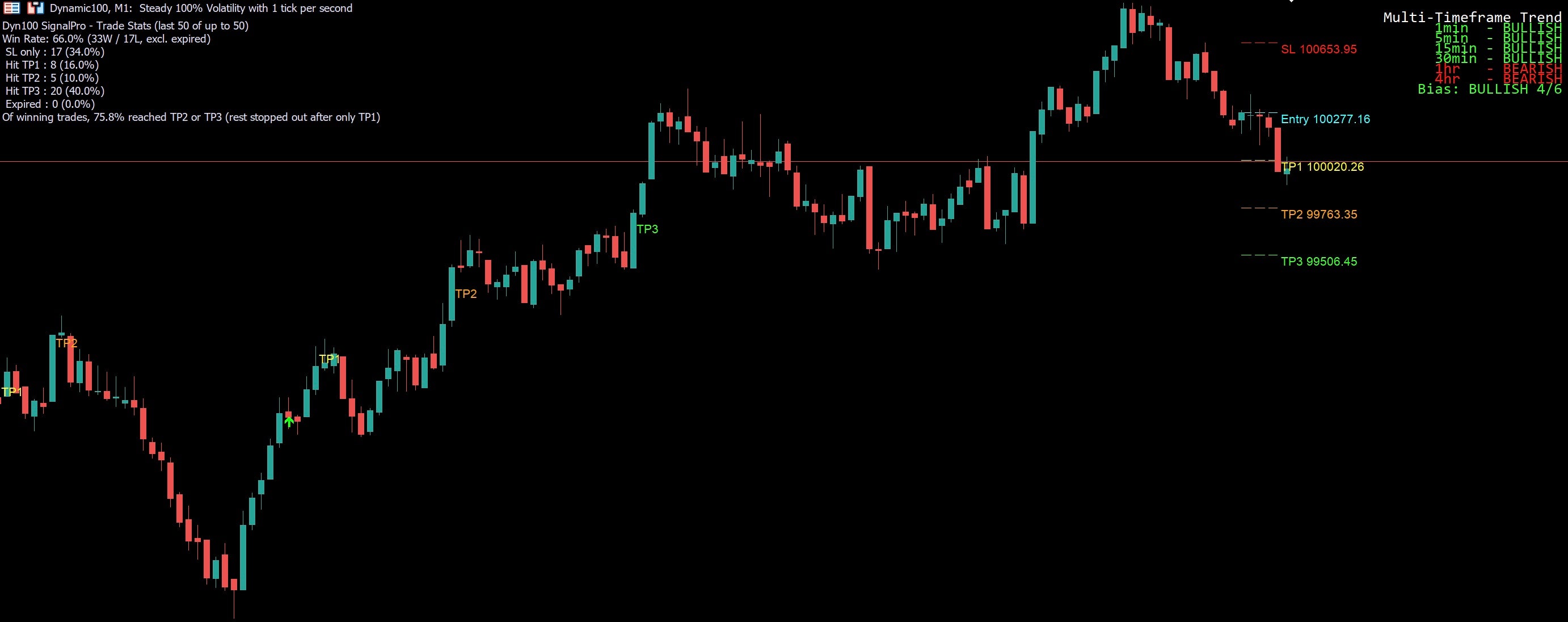
The player above is a simulation. This is Scout running in MetaTrader 5. One licence covers one instrument: choose V100 or D100.
The Scout masterclass
Set Scout up properly, read what it shows honestly, and keep every decision yours. 6 short lessons, about 34 minutes, in your account as soon as your order is paid. It isn't sold on its own.
Also included: Trading Synthetic Indices.
- Install Scout on Windows or Mac and paste your key code
- Set up the pop-up alert and one chart tab per timeframe
- Read the stats panel honestly: what counts as a win, and what it leaves out
- Measure Scout’s targets in R and choose your own stop, target and size
Before you buy
Three things to have ready. Without them, the indicator can't be activated.
How you get Scout
From order to your first alert. Your indicator arrives by email within 12 hours of your payment reflecting.
- 01
Order
Check out with the MT5 account number you'll trade on. Only the number: we never ask for your MT5 password.
- 02
Pay by EFT
We show the bank details, your payment reference and the amount. Pay, then email us your proof of payment.
- 03
We build it
Once your payment reflects, we build the indicator for your MT5 account, with your licence period built in.
≤ 12 HOURS AFTER PAYMENT - 04
Delivered
It arrives by email with a step-by-step installation guide and our tips and tricks.
- 05
Install and trade
Add it to MT5 on your laptop or PC as the guide shows. It marks setups and raises an alert. You decide every trade.
- It only runs on the MT5 account number it's built for. Changing accounts? Email us and we'll move it for you.
- Send your proof of payment to manifestmarketsonline@gmail.com, with your order number as the subject.
- Allow up to 12 hours after your payment reflects. Instant payments usually reflect straight away; an ordinary EFT can take up to two working days.
- If your account number doesn't look right, we'll email you to check it. Replying quickly gets you set up sooner.
- We will never ask for your MT5 password. If anyone asks for it on our behalf, it isn't us.
Trading carries risk, and Scout doesn't remove it. Synthetic indices can move quickly and without warning. It's a tool to support your own analysis, not a guarantee of profit, and two traders can take the same setup and get different results. Only trade with money you can afford to lose.
Read the risk disclosureQuestions about Scout
Does one licence cover both V100 and D100?
Which broker do I need?
Can Scout predict synthetic indices?
Why is Scout cheaper?
Can I practise on demo first?
Does it work on the MT5 phone app?
The rest of the crew
Different markets, a different pace, the same way of working.